
We all watched closely as the U.S. midterm elections came and went. The results were significant, with Democrats gaining control of both the House of Representatives and the Senate.
Today, I want to spend a few minutes talking about what this means for decision-making in Washington, how markets have reacted, and, most importantly, what it could mean for your investments.
Hi, I’m Chad…
As many of you know, Republicans previously controlled the Senate, the House and the Presidency. Now, with Democrats controlling both chambers of Congress, we’re looking at a divided government for the final two years of President Trump’s term.
So, what does this actually mean?
At a minimum, I think we’ll see more oversight and potentially more friction when it comes to getting legislation passed. There will likely be more negotiation and, in some cases, greater difficulty reaching agreement on significant policy initiatives.
Whether you view that as positive or negative is really a matter of personal perspective. From an investment standpoint, what matters is how these changes affect government policy and the overall business environment.
I think there will be some uncertainty around regulation and the direction of certain industries. The Trump administration has been fairly clear about its priorities in areas like artificial intelligence, cryptocurrency, energy and trade. With Democrats now controlling Congress, there could be greater scrutiny of some of these initiatives.
That doesn’t necessarily mean the direction of these industries will change, but it could make the path forward less predictable.
Okay, let’s talk about markets.
The initial reaction was somewhat mixed. Global markets initially came under pressure, particularly in some AI-related companies. However, U.S. markets subsequently rallied, and government bond yields declined.
Why did this happen?
If you’ve watched my previous videos, you may remember that I’m pretty skeptical of the narratives people attach to daily market movements. I think a lot of pundits give themselves more credit than they deserve. It’s often much easier to explain why something happened after the fact than it is to predict it beforehand.
With that said, it’s plausible that investors are considering whether increased regulatory oversight could affect the enormous investment taking place in AI infrastructure and data centres. But I wouldn’t be too quick to attribute every market movement to the election.
So, what does this mean for you moving forward?
Historically, markets have tended to perform reasonably well in the year following midterm elections. One explanation is that some of the uncertainty surrounding elections and future government policy gets removed once the results are known.
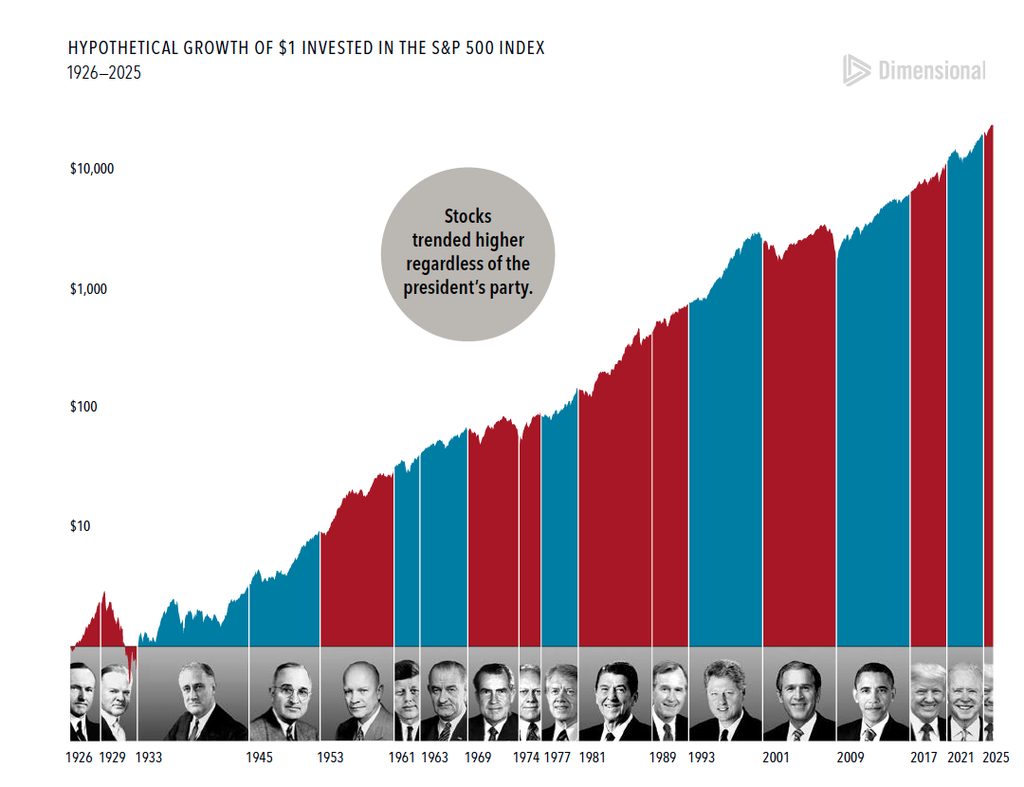
But I wouldn’t put too much emphasis on that historical pattern. There’s no guarantee it will repeat. And when you look at the longer-term data, there really isn’t a reliable relationship between which political party controls Congress and how the stock market performs.
This slide from Dimensional Fund Advisors illustrates that point quite well. It shows the growth of the stock market over time, under both Democratic and Republican administrations. Neither party has consistently produced better market returns.
And when you think about it, that makes perfect sense.
There are so many other factors that will ultimately determine the value of businesses and their future earnings. What will corporate earnings look like? Where will interest rates go? What new technologies will emerge? What will economic growth look like? What geopolitical events may occur?
I’d argue that the answers to these questions are considerably more important to long-term investment returns than which political party happens to be in power.
The same applies to bonds. Government spending and policy decisions can influence interest rates, but inflation, economic growth and central bank policy will remain much more important drivers of bond market performance over time.
So, while the pundits on the business channels debate how every political development might affect stock prices on any given day, you can continue focusing on what’s important to you.
Your portfolio has been designed around your financial goals, time horizon and tolerance for risk, with diversification and sound investment principles at its core.
Our advice this time is no different.
Stay invested. Stay diversified. And maintain a portfolio you’re comfortable with.
We can’t predict the future, but we’ll continue working hard to tilt the odds in your favour and help you make the best possible financial decisions for yourself and your family.
I’m Chad Butnari with Assante Wealth Management. Thanks for watching. And if you have any questions, or someone you care about is looking for help making your own financial decisions, we’re always happy to help.